
How can brands secure consistent, high-quality audience attention in dense urban markets? Transit advertising integrates brand messaging directly into daily urban mobility, delivering high contact frequency, prolonged dwell times, and unskippable physical visibility across transit vehicles, stations, and key municipal corridors.
Transit advertising continues to capture market momentum as commuter volume rebounds across major metropolitan areas. Data from the American Public Transportation Association (APTA) indicates public transit ridership has recovered to approximately 80% of pre-pandemic baselines, recording 7.1 billion trips in 2023 alone, a 16% increase year-over-year. Media investment has mirrored this audience migration.
According to the Out-of-Home Advertising Association of America (OAAA), transit ad spend represented the fastest-growing OOH segment in early 2024, expanding by 18.8% in Q1. For brands aiming to establish an authoritative presence in the urban landscape, transit media provides continuous, scalable touchpoints throughout the commuter journey.
What is transit advertising and how does OOH reach audiences on the move?
Transit advertising encompasses Out-of-Home (OOH) and Digital Out-of-Home (DOOH) formats placed across municipal transit networks, including buses, trams, commuter rail, subways, taxis, and transit infrastructure.
Unlike static roadside media, transit formats introduce dynamic movement, navigating through varied commercial districts, business centers, and residential corridors. This continuous mobility ensures that brand exposure aligns with the daily operational rhythm of the city.
The medium operates effectively by capitalizing on specific cognitive contexts: active transit, station waiting periods, and pedestrian circulation. Because transit advertising exists within the physical environment, it operates independently of ad-blockers and algorithmic fatigue. Repeated contact along standardized commuter routes builds brand familiarity, driving structured recall and strategic top-of-mind awareness over extended campaign flights.
How does transit advertising differ from other OOH formats?
While traditional roadside billboards occupy fixed geographic coordinates, transit advertising moves across diverse urban zones throughout the day. This dynamic circulation extends campaign coverage into high-density retail and residential areas where static large-format inventory may be restricted.
A full vehicle wrap, for example, functions as high-impact mobile media, achieving visibility among passengers, parallel vehicular traffic, and pedestrians along key urban arteries.
Transit media also offers proven efficiency in media planning. A 2022 Solomon Partners analysis highlighted transit shelters as having one of the most competitive median CPM benchmarks across measured media, at $2.18 per 1,000 impressions.
For mid-sized and large enterprises, this efficiency allows media planners to achieve broad market penetration and consistent contact frequency within targeted budgetary allocations.
Where does transit advertising appear?
Transit media touchpoints span multiple contextual environments across the passenger journey:
- On vehicles: Bus wraps, side panels, tram wraps, passenger rail interiors, subway car cards, and taxi media.
- In stations and terminals: Backlit platform posters, large-format terminal displays, tunnel banners, and high-definition DOOH screens.
- Street-level public infrastructure: Citylight displays on passenger shelters, urban kiosks, and street furniture.
- Specialized formats: Mobile LED displays and fleet integrations deployed for event-driven or location-specific activations.
Explore public transport advertising in Poland →


FILL OUT THE FORM
GET A FREE QUOTE AND CONSULTATION!
Types of transit advertising: formats and placement options
Selecting transit formats requires aligning the creative execution with audience dwell time and viewing distance. Rapid pedestrian or driver exposure demands high-impact visual clarity, whereas captive in-transit audiences accommodate detailed informational storytelling.
Media planning strategy dictates format selection based on campaign objectives, whether the focus is broad brand building, retail activation, or context-driven engagement.
Bus advertising
Buses offer substantial surface area and broad geographic circulation through primary commercial and municipal arteries. A full vehicle wrap delivers maximum visual impact, commanding attention across multi-lane traffic corridors. These placements simultaneously address in-vehicle passengers and external street-level audiences along established municipal routes.
Standard bus formats include:
- Bus Kings / Ultra Kings: Large exterior side panels that deliver large-format impact along primary traffic flows at an optimized production cost.
- Double Decker Wraps: High-profile, elevated placements utilized in central business districts and high-traffic tourist corridors.
- Interior cards and passenger displays: Dedicated internal panels visible to seated and standing commuters throughout prolonged transit durations.
Campaigns can be strategically routed to target specific commercial zones, corporate hubs, or retail districts across major metropolitan areas.
Train and subway advertising
Subway and rapid transit networks deliver high passenger density in major urban hubs. Commuters maintain sustained physical proximity to media inside rail cars and across station platforms, creating ideal conditions for cognitive retention.
Core rapid transit options include:
- Full Car Takeovers: Comprehensive branding across all interior panels within a single train car, creating an immersive brand environment.
- Station Dominations: Coordinated takeovers of all available platform and concourse media within high-volume central interchange hubs.
- Pedestrian tunnel wraps: Large-format sequential vinyl displays in high-footfall connecting corridors.
- Subway DOOH networks: Synchronized digital displays supporting high-definition motion creative and dayparted messaging.
Commuter rail and light rail placements
Commuter and light rail lines bridge suburban residential areas and central business districts, reaching key demographics including corporate decision-makers, professionals, and students. Formats mirror subway systems, focusing on platform citylights, interior displays, and concourse takeovers.
The integration of Digital Liveboards across major rail hubs provides dynamic full-motion capabilities. Placements can be automated based on time-of-day parameters, ambient weather data, or contextual market updates, maintaining relevance throughout daily commute peaks.
Airport and airline ads
Airport environments provide access to high-value passenger segments, including executive business travelers and international consumers. Aviation hubs feature extended dwell times, creating an optimal setting for premium brand positioning.
Standard airport media options include:
- Large-format digital screens in departures, arrivals, and main concourses
- Backlit prestige displays along primary passenger walkways
- Baggage claim carousel dominations and surrounding digital totems
- Branded terminal shuttles and airside transport fleets
- Sponsorships of premium passenger lounges and interactive service amenities
Industry research confirms elevated ad recall in airport terminals, where an estimated 90% of travelers actively process ambient visual media during extended pre-boarding windows.
Taxi and ride-share advertising
Taxis and ride-share fleets operate continuously across high-density commercial centers, hotel corridors, and nightlife districts. These vehicles penetrate congested downtown zones where vehicle speeds are low, extending visual dwell time for surrounding drivers and pedestrians.
Primary formats include:
- Full vehicle branding: Transforming the vehicle exterior into a dynamic mobile advertisement.
- Digital vehicle toppers: High-brightness DOOH units capable of programmatic scheduling and geo-targeted creative rotation.
- Internal digital screens: Interactive displays delivering targeted video content directly to passengers during transit.
Digital taxi displays enable tactical campaign agility, allowing brand managers to deploy targeted messaging responsive to specific neighborhoods and immediate timeframes.
Ferry and maritime media
In metropolitan areas incorporating water transit, maritime advertising provides extended, uninterrupted audience exposure within a calm transit environment, supporting elevated attention metrics.
Key maritime media options include:
- Vessel Takeovers: Exterior hull branding combined with complete interior lounge branding.
- Onboard Digital Screens: High-definition displays broadcasting brand video throughout transit lounges.
- Bulkhead and cabin posters: Eye-level placements maintaining continuous exposure across 20- to 45-minute crossing periods.
Digital and programmatic transit OOH
Digital Out-of-Home (DOOH) integration across transit infrastructure, including digital bus shelters, platform totems, and onboard displays, provides campaign adaptability. Digital inventory allows marketing teams to calibrate creative delivery based on temporal, weather, and logistical triggers.
Programmatic DOOH (pDOOH) enables modern media buyers to purchase transit inventory using automated platforms. This infrastructure supports:
- Audience-led behavioral targeting
- Data-driven budget pacing and live flight optimization
- Centralized performance verification and reporting
- Custom dayparting matched to precise commuter flow patterns
Key benefits of transit advertising for brands
Transit advertising aligns brand communication with the regular mobility habits of urban consumers. Deploying media across primary commuter pathways secures broad reach, strong contact frequency, and reliable message retention.
1. High-frequency exposure and audience reach
Transit media builds familiarity through scheduled repetition. Daily commuters traveling along consistent routes encounter the same campaign touchpoints multiple times per week, reinforcing brand awareness and message comprehension.
Furthermore, exterior vehicle media functions beyond passenger ridership. Formats on buses and surface transport generate substantial impression volumes among pedestrians, cyclists, and surrounding vehicular traffic across the metropolitan grid.
2. Geographic and community targeting
Because municipal transit operates along defined routes and station stops, campaigns can be calibrated geographically. Media planning can isolate specific municipal lines and interchange stations to align with demographic targets.
Strategic deployment examples:
- QSR and retail brands targeting bus routes adjacent to regional shopping centers.
- Financial and B2B brands securing commuter rail lines serving central financial districts.
- Localized creative variants deployed across specific municipal sectors.
With a substantial proportion of urban workplaces situated near transit hubs, station and transit media consistently reaches active workforce demographics near points of commercial decision-making.
3. Long dwell times for ad engagement
Transit networks inherently involve extended waiting and travel periods. National statistics indicate average urban transit commutes often exceed 40 minutes per trip, establishing a captive audience environment conducive to detailed message processing.
Engagement benchmarks underscore this dynamic:
- Airport advertising studies indicate up to 85% of premium travelers express willingness to engage with terminal commercial messaging.
- Industry data shows over 54% of consumers consistently notice DOOH transit screens in stations, with a significant proportion subsequently conducting digital searches or retail visits.
4. Expanding reach beyond riders
Vehicle wraps and street furniture operate as public space media. A fully branded bus or tram delivers broad atmospheric reach across non-riders navigating commercial corridors, ensuring campaign visibility extends throughout the broader urban population.
5. Cost-effectiveness and scalable budgets
Transit OOH provides competitive CPM efficiency relative to traditional broadcast and fragmented digital channels. The low entry CPM across formats like transit shelters enables sustainable, multi-week media presence without rapid budget exhaustion.
Campaign structures scale effectively across strategic tiers:
- Focused route-based campaigns supporting regional activations
- Multi-line vehicular fleets securing citywide visibility
- Comprehensive station takeovers paired with programmatic DOOH networks for national launches
Once deployed, physical static placements deliver continuous impressions throughout the flight duration without exposure to dynamic real-time ad bidding inflation.
6. Consistent visibility during daily commutes
Transit advertising forms a persistent element of the urban environment. Unobstructed by ad-blocking tools or algorithmic filtering, physical transit media ensures brand visibility remains constant across peak commuting hours, building the institutional familiarity essential for long-term brand equity.
Smart strategies for effective transit OOH campaigns
Maximizing the impact of transit media requires structured planning, precise format selection, and creative built specifically for dynamic viewing conditions.
Mapping the commuter journey
Campaign architecture should map directly to passenger movement cycles across the day:
- Morning peak: High-density workforce and student transit toward central business and education zones.
- Midday: Retail, service, and leisure-oriented urban foot traffic.
- Evening peak: Return transit flows receptive to entertainment, dining, and lifestyle messaging.
Aligning placements with these journey phases ensures messaging contextual relevance throughout the transit cycle.
Choosing key routes and stations for impact
Media efficiency relies on strategic inventory selection rather than uncurated volume buys. Planners prioritize transit corridors that intersect with target audience concentrations.
Strategic approaches include:
- Airport and express rail lines for senior business demographics
- Commuter rail connecting affluent residential zones to corporate hubs
- Bus lines traversing high-density shopping districts and university campuses
Adapting creative for moving environments
Transit creative must account for relative motion, viewing angles, and exposure windows. Media running on external vehicle panels requires rapid visual decoding, whereas station and interior placements allow for deeper narrative depth.
Strategic creative allocation:
- High-speed contact (vehicle exteriors, roadside shelters): High contrast, minimalist copy, and clear logo positioning.
- Extended dwell contact (station concourses, vehicle interiors): Multi-layered messaging, detailed product benefits, and clear calls to action.
In digital formats, automated triggers can align creative copy with live environmental factors such as temperature, precipitation, or local time.
Integrating mobile and digital elements for cross-channel engagement
Transit campaigns amplify omnichannel performance when paired with mobile touchpoints:
- Contextual QR codes on interior and platform placements for direct digital conversion.
- Mobile geofencing to deliver coordinated programmatic display ads to audiences traversing key transit hubs.
- Device telemetry analysis to evaluate post-exposure consumer actions across digital channels.
This integration establishes direct attribution between physical OOH exposure and downstream web traffic, search volume, or footfall.
Diversifying formats for full-day exposure
A multi-format transit strategy secures successive touchpoints throughout the consumer’s daily routine:
- Morning: Digital transit shelter display near departure points
- In-transit: Dedicated interior rail cards or in-vehicle screens
- Urban movement: Large-format exterior bus wraps circulating city commercial centers
This multi-tiered deployment reinforces cognitive retention through contextual variation.
See bus advertising formats and coverage →
Creative best practices for transit advertising
High-density urban environments present significant visual competition. Transit creative must be structured for immediate clarity and cognitive impact.
Clear and concise messaging
External transit displays provide visual windows of only a few seconds. Copy should focus on a singular, direct value proposition. Long sentences and complex typography reduce comprehension in fast-moving environments.
Eye-catching design for high traffic areas
Legibility under varied lighting and motion conditions is critical:
- Select bold, heavy-weight typography with adequate kerning.
- Maintain strong tonal contrast between text elements and background imagery.
- Utilize clear visual hierarchy to guide immediate eye tracking toward the brand asset.
Contextual relevance to commuters and bystanders
Messaging that reflects the immediate situation of the commuter generates higher engagement. Breakfast promotions perform best during morning rush hours, while entertainment campaigns capture attention during evening commutes.
Digital networks allow real-time creative adaptation based on:
- Dayparting schedules
- Local meteorological conditions
- Scheduled city events and entertainment calendars
- Live public transport service information
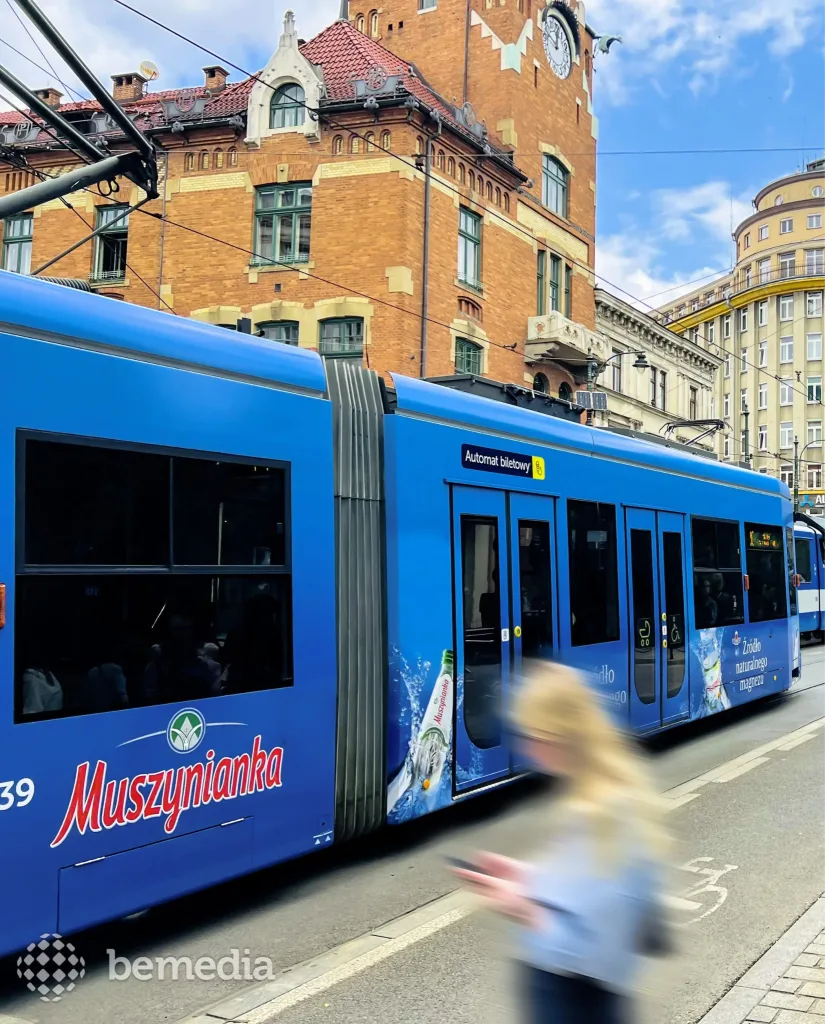
Vehicle wraps turn public transport into a mobile advertising format that stays visible throughout busy urban routes.
Targeting and measurement: optimizing transit campaign performance
Modern transit OOH incorporates sophisticated analytical models and programmatic execution, providing robust targeting precision and verifiable post-campaign attribution.
Using programmatic DOOH for dynamic optimization
Programmatic DOOH platforms allow planners to deploy data-driven triggers across transit networks. Campaigns can automate impression delivery to coincide with specific traffic thresholds, passenger densities, or weather patterns, maximizing media spend efficiency.
Tracking audience reach and campaign results
OOH measurement methodologies now utilize multi-source attribution frameworks:
- Impression and reach validation: Audited passenger counts and vehicular flow data verified against independent industry standards.
- Brand lift studies: Pre- and post-campaign market surveys quantifying shifts in brand consideration and recall.
- Foot traffic attribution: Anonymized mobile location data connecting exposed consumer cohorts to physical store visits.
- Digital response metrics: Direct tracking via custom campaign landing pages, dynamic QR scans, and localized search spikes.
- Execution verification: Timestamped display logs and photographic proof-of-play documentation.
- Telemetry analysis: Sensor-based audience measurement providing granular validation of exposure frequency within transit environments.
Benchmark volume indicators:
- A dedicated 30-bus exterior campaign in a tier-one metropolitan market typically generates between 1 and 3 million weekly impressions.
- Subway interior campaigns spanning 20 cars across major lines deliver 500,000 to 1.5 million weekly unique passenger contacts.
Adapting placements based on real-time data
Digital transit screens allow marketing teams to adjust flight pacing and creative variants dynamically. Shifting messaging between morning commute objectives and evening retail prompts maintains contextual alignment and improves consumer engagement rates.
Transit advertising costs and budgeting for citywide coverage
Transit advertising rates vary based on market tier, selected format, production complexity, and total campaign scale. Constructing an efficient media plan requires understanding the fundamental cost drivers.
Factors affecting transit OOH rates
Core pricing parameters include:
- Market tier and density: Major metropolitan centers command higher baseline inventory rates due to higher passenger density.
- Format specifications: Comprehensive full-vehicle wraps require higher capital outlay than standard interior cards.
- Flight duration: Multi-month commitments typically achieve improved rate efficiency.
- Fleet volume: Larger vehicle deployments unlock tiered volume pricing.
- Route premium: High-traffic central business corridors may carry location-specific premiums.
- Production and installation: Material printing, vinyl application, and maintenance fees.
- Data and verification: Technical fees associated with programmatic bidding platforms and third-party measurement studies.
Typical budget ranges for different formats
Indicative commercial pricing benchmarks across metropolitan transit formats:
| Format | Estimated Cost Benchmark | Strategic Application |
| Subway Interior Car Cards (Standard) | $80 to $250 per card / month | Targeted passenger exposure with extended reading time |
| Bus Exterior Side Panels (King formats) | $300 to $1,500 per unit / month | High-visibility street presence in urban traffic flows |
| Bus Exterior Ultra Kings / Large Panels | Up to $2,500 per unit / month | Enhanced visual impact across high-density vehicle routes |
| 30-Bus Exterior Fleet Flight (4 weeks, Tier 1 city) | $40,000 to $100,000 | Comprehensive municipal coverage including production |
| Central Station Domination | $50,000+ per flight | High-impact brand exclusivity across major passenger hubs |
| Specialized transit activations | From $3,500 | Event-driven or localized tactical campaigns |
How to maximize ROI in transit campaigns
Key strategic practices to optimize transit media investments:
- Align routes precisely with target demographics: Focus investment on lines connecting specific residential and employment centers to eliminate wasted coverage.
- Deploy programmatic DOOH for flexibility: Utilize dynamic scheduling to deliver impressions during optimal audience concentration windows.
- Integrate digital response mechanisms: Incorporate scannable prompts and mobile retargeting to bridge physical exposure with measurable online actions.
- Execute multi-format media mixes: Combine moving exterior formats with captive interior placements to build both broad reach and message depth.
- Monitor performance attribution: Refine continuous campaign flights using mobile foot traffic and digital uplift analytics.
Why transit OOH keeps your brand moving forward
Transit advertising embeds brand messaging directly within the physical flow of urban commerce.
As metropolitan populations expand and public transit maintains its central role in daily mobility, transit OOH provides brands with reliable, unskippable exposure across high-density consumer environments.
The convergence of physical scale with digital programmatic precision ensures that transit media delivers both massive reach and measurable audience engagement.
By strategically aligning formats, geographic routing, and contextual creative, transit campaigns build consistent brand recognition that moves seamlessly alongside the modern consumer.
We will promote your business!
Frequently asked questions about transit advertising
Below are direct strategic answers to standard logistical and operational questions regarding transit media planning.
How long does it take to launch a transit ad campaign?
Standard physical transit campaigns require a lead time of 2 to 4 weeks from contract execution to live display. This period accounts for creative technical review, municipal transit authority approvals, large-format printing, and depot installation scheduling.
Rush options in specific markets can compress production timelines to 7 to 14 days. Digital Out-of-Home networks offer rapid deployment, with approved digital assets going live within 48 to 72 hours.
What cities offer the widest transit OOH reach?
In major markets, cities with extensive multi-modal transit networks, such as New York, London, Tokyo, and major European hubs, provide comprehensive inventory across subway, rail, and bus fleets. Strategic media planning agencies coordinate multi-market campaigns nationwide through established operational networks in all primary urban centers.
What are the most effective formats for different objectives?
Format selection should directly align with core campaign goals:
- Broad market awareness: Full exterior bus wraps and double-decker formats.
- Immersive storytelling: Station dominations and full rail car takeovers.
- Detailed product education: Interior rail and bus passenger cards.
- Dynamic, tactical promotions: Digital taxi toppers and programmatic transit DOOH networks.
- Geographic targeting: Route-specific bus lines and localized passenger shelters.
- High-income audience reach: Airport terminal displays and premium executive lounges.
How is audience measurement conducted in transit OOH?
Transit audience measurement utilizes audited data streams including:
- Audited transit authority circulation: Verified ticketed passenger counts and vehicular route traffic modeling.
- Brand lift studies: Standardized statistical analysis tracking changes in consumer awareness and brand consideration.
- Mobile location attribution: Anonymized GPS mapping connecting physical exposure zones to retail store footfall.
- Direct response tracking: Dedicated URL tracking, campaign-specific promo codes, and dynamic QR code interactions.
- Digital retargeting passback: Aggregated device exposure data applied to secondary programmatic display funnels.
- Proof of performance reporting: GPS-tagged installation photography and programmatic display verification logs.
- In-transit telemetry: Network sensor systems verifying passenger volume patterns across key municipal routes.