
How do brands strategically plan and execute airport advertising campaigns that deliver measurable market impact?
Successful airport media planning combines high-visibility digital and static formats with environments characterized by extended passenger dwell time, premium audience demographics, and high receptive attention across the terminal journey.
What is airport advertising?
Airport advertising encompasses the strategic placement of out-of-home (OOH) and digital out-of-home (DOOH) media across airport terminals, concourses, and transit connections. The ecosystem spans large-format digital video walls, backlit static dioramas, baggage claim wraps, security checkpoint branding, and tailored lounge activations. Because airports concentrate business decision-makers, international travelers, and high-income consumers in a state of heightened awareness, the environment commands a distinct premium within the global media landscape.
The global airport advertising market was valued at approximately $4.24 billion in 2024 and is projected to reach $7.43 billion by 2033, expanding at a compound annual growth rate (CAGR) of 6.1%. This trajectory reflects sustained corporate investment in physical brand presence across global transit hubs. In the United States alone, airport passenger volumes exceed 1 billion travelers annually, providing scalable reach for regional, national, and international brand campaigns.
How does airport advertising reach travelers?
Airport advertising functions through a sequence of predictable touchpoints that align with the passenger journey. Travelers moving through an airport operate with heightened situational awareness compared to standard urban environments. From curbside drop-off through check-in, security screening, retail corridors, and boarding gates, passengers systematically navigate controlled pathways with built-in dwell periods.
Average passenger dwell time frequently exceeds 60 to 90 minutes across the pre-flight experience. This prolonged exposure allows brands to achieve multiple message contacts without cognitive fatigue. High-density zones-such as security lines, gate waiting areas, and baggage claim carousels-transform idle waiting periods into windows of high-quality attention,driving strong brand recall and message retention.
Benefits of advertising in airports
Integrating airport media into a cross-channel media strategy delivers several measurable advantages:
- Demographic Profile: Airport environments over-index in business executives, corporate decision-makers, and consumers with above-average disposable income.
- Global and Regional Scale: Hub airports enable brands to reach concentrated international and domestic audiences within a single physical footprint.
- Contextual Prestige: Modern terminal architecture elevates brand perception, situating corporate messaging within an environment associated with innovation, commerce, and trust.
- Format Versatility:Media options range from immersive, full-motion DOOH networks to persistent static displays and interactive experiential zones, supporting both brand awareness and direct engagement objectives.
Check airport advertising options in Poland


FILL OUT THE FORM
GET A FREE QUOTE AND CONSULTATION!
What are the main airport advertising formats?
Media selection in an airport depends on passenger velocity and mindset at each specific touchpoint. Fast-moving transit corridors require high-impact visual clarity, whereas gate lounges and arrival halls accommodate detailed brand storytelling and interactive calls to action.
Digital screens and video networks
Digital out-of-home (DOOH) networks represent the fastest-growing segment of airport advertising. These high-definition displays are situated across main concourses, central rotundas, and baggage claim areas. They support dynamic content delivery, scheduled creative rotations, full-motion video, and rapid copy updates.
Key digital placements include vertical concourse totems, synchronized digital ribbons, gate information networks, and Flight Information Display System (FIDS) adjacent screens. Large-format digital spectaculars-often positioned above escalators or central terminal intersections-serve as dominant visual anchor points for flagship brand launches and high-impact corporate announcements.
Static billboards and banners
Static displays provide continuous, 100% share-of-voice exposure. Backlit dioramas remain a core format across gate concourses, ticketing zones, and baggage halls, offering vibrant, high-contrast illumination at a predictable cost base. In larger spaces, tensioned fabric banners, structural column wraps, and architectural wall panels create bold visual dominance.
Static formats are particularly effective for long-term brand positioning, major corporate repositioning, and sustained market presence where continuous visual repetition is required.
Baggage claim displays and carousels
Arrival areas represent an environment of exceptionally high dwell time. Arriving passengers typically spend 15 to 25 minutes waiting in baggage claim, experiencing a relaxed mindset following flight completion.
Placements include digital screens positioned directly above carousels, vinyl wrap branding on the conveyor belts, illuminated backdrops, and luggage trolley sponsorships. This zone provides the initial market impression for incoming travelers, making it a prime location for regional hospitality, automotive, financial services, and B2B infrastructure messaging.
Jet bridge and gate area placements
Jet bridges and gate holding lounges offer a captive communication environment. Boarding passengers navigate dedicated corridors where visual competition is minimal. Formats include interior wall panels, exterior glass wraps, and gate-adjacent digital units.
Because passenger flow slows during boarding and deplaning, jet bridge media delivers high visual attention directly prior to departure or upon immediate arrival.
Security tray and checkpoint branding
Security checkpoint media provides mandatory physical contact with 100% of departing passengers. Branding applied to security screening trays and divestment tables achieves direct tactile engagement during a focused transition point in the terminal journey.
This high-frequency touchpoint ensures unavoidable visibility across the entire departing demographic, generating millions of verified physical impressions over extended campaign flights.
Floor decals, wraps, and window clings
Architectural media solutions convert terminal infrastructure into dedicated brand environments. High-durability floor graphics, expansive glass window clings, and corridor wraps integrate directly with the terminal space.
These formats are commonly deployed to establish dedicated brand corridors, guide foot traffic toward specific terminal experiences, or create an immersive visual presence that spans an entire concourse.
Airport transit, shuttle, and parking area ads
Airport campaigns often extend beyond the terminal interior into exterior transit ecosystems. Media inventory includes full wraps on inter-terminal shuttles and rail systems, illuminated parking garage displays, and roadside billboards along main access routes.
These exterior formats capture travelers, airport employees, and ground transportation operators at the immediate entry and exit points of the airport grounds, establishing early campaign frequency.
Retail, lounge, and experiential activations
Terminal retail areas, duty-free zones, and premium airline lounges cater to specific consumer mindsets. Media in retail zones engages travelers who are actively browsing and prepared to purchase, while airline business lounges provide exclusive access to C-suite executives and frequent corporate flyers.
For deeper audience engagement, brands can execute physical pop-ups, interactive product demonstration kiosks, and sponsored airport Wi-Fi landing pages that capture verified digital interactions.
See airport campaigns for tourism and hospitality brands
What do airport advertising formats cost?
Airport advertising rates reflect traffic scale, terminal placement, format exclusivity, and seasonal demand. Investment levels range from several thousand dollars for regional digital network insertions to six-figure commitments for long-term hub dominations or high-profile spectaculars.
Factors affecting airport advertising rates
Several strategic variables determine airport media pricing:
- Passenger Volume and Hub Classification: Global gateway hubs command higher absolute rates than regional airports due to audience scale and international demographic reach.
- Placement and Visibility: Prime central terminal nodes and security checkpoints command higher rates than secondary concourse hallways.
- Audience Dwell Time: Locations characterized by extended wait times (lounges, gates, baggage claim) carry higher media values than rapid transit corridors.
- Terminal Infrastructure: Premium digital assets with high resolution and exclusive audio-visual capabilities reflect advanced hardware investment.
Price ranges for digital vs. static formats
Digital and static airport media operate on distinct pricing structures:
- Digital (DOOH): Typically sold via share-of-voice (SOV) loops (such as a 10-second spot in a 60-second loop) or traded programmatically on a cost-per-thousand (CPM) model.
- Static OOH: Priced as exclusive fixed placements sold in standard four-week cycles.
National airport DOOH campaigns generally operate within an average CPM range of $20.75 to $117.50 (with a media median near $86.50), reflecting the premium demographic density of the audience.
Programmatic airport inventory typically transacts at median rates between $11.50 and $19.25 CPM depending on targeting parameters. Prime static concourse locations typically range from $6,000 to $18,000 per four-week period depending on terminal traffic volume.
Cost comparison by airport location and size
Media valuation correlates with passenger throughput and market profile, as illustrated in historical operational performance benchmarks:
| Airport | Traffic reference | Ad revenue (reported) | Approx. revenue per passenger |
| Omaha Eppley Airfield | 5.3M passengers (2024) | $953,000 | $0.18 per passenger |
| Tri-Cities (Pasco, WA) | 525,838 enplanements (2025) | $132,496 | $0.25 per enplanement |
While tier-one international gateways offer massive impression volume and prestige, regional facilities provide cost-effective opportunities for total terminal market share and targeted regional visibility.
Minimum spend and campaign duration
Airport advertising contracts are traditionally structured around four-week media cycles, with annual commitments commonly deployed for corporate brand positioning. Minimum entry budgets vary significantly by tier: localized regional campaigns can be executed for modest entry budgets, whereas comprehensive multi-terminal programs across major national hubs require substantial capital allocation.
Additional production and installation fees
Media plans must incorporate technical production and site operations alongside core media space costs:
- Production: High-resolution digital rendering, static substrate printing, specialized backlit film production, and UV-resistant architectural vinyl manufacturing.
- Installation and Logistics: On-site execution within secure terminal zones requires badged personnel, night-shift labor, and strict compliance with airport authority operational standards.
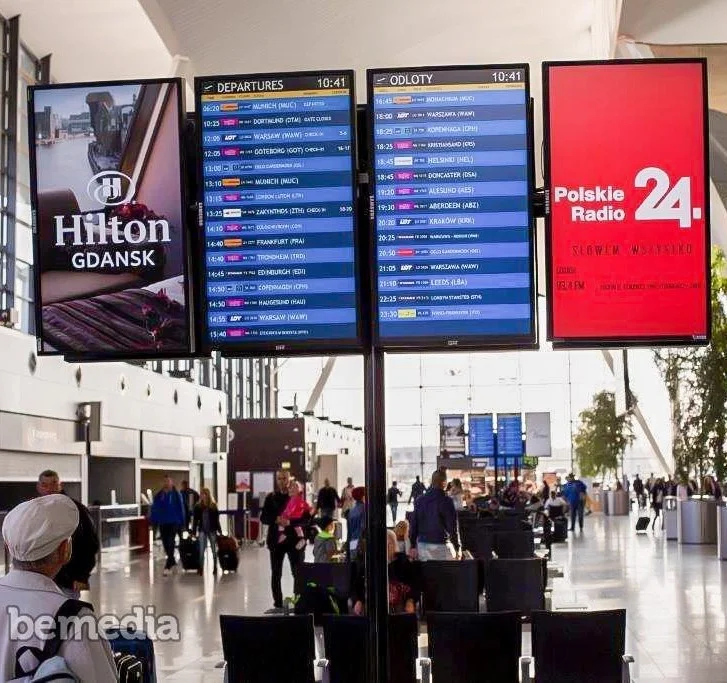
Airport digital signage combines essential flight information with high-visibility advertising, allowing brands to engage travelers in busy transit environments where digital screens naturally attract attention.
How to plan and book airport advertising
Planning an airport media campaign requires aligning brand goals with physical passenger logistics to ensure optimal creative visibility and contact frequency.
Key steps for launching an airport ad campaign
Executing an effective airport media deployment requires clear strategic sequencing:
- Establish Clear Objectives: Align media choices with core outcomes, whether driving broad market prestige, reaching enterprise decision-makers, or prompting point-of-sale action.
- Target Key Touchpoints: Select placements that correspond with required dwell times-using high-dwell gate and lounge zones for detailed messaging and concourse screens for visual branding.
- Prioritize Visual Hierarchy: Design bold, legible creative that communicates value within three to five seconds.
- Ensure Cross-Format Consistency: Deploy synchronized visual assets across multiple terminal touchpoints to reinforce recall across the passenger journey.
Artwork requirements and creative best practices
Creative assets must adhere strictly to technical specifications provided for each physical and digital asset. Print units require precise bleed margins and certified flame-retardant, high-durability substrates. Digital assets must match native display resolutions, frame rates, and color profiles to maintain visual quality across large-scale LED and LCD installations.
Booking timelines and lead times
Because premium airport inventory operates at high occupancy levels, strategic media planning should commence well in advance. Creative files must generally be submitted for airport authority review at least ten working days prior to campaign launch to accommodate security clearances and testing. Major holiday seasons and high-traffic event periods often require inventory reservation months ahead of execution.
Working with airport media owners and agencies
Executing campaigns across multiple domestic or international hubs requires specialized media coordination. Partnering with an experienced media planning agency simplifies campaign management through unified strategy, consolidated contracting, verified proof-of-performance reporting, and strategic format selection tailored specifically to campaign KPIs.
Request a free airport campaign cost estimate
We will promote your business!
Frequently asked questions
The following technical considerations address common operational inquiries regarding airport media planning.
Are airport ads available in all airports?
Advertising inventory is established across virtually all primary, secondary, and regional commercial airports globally. Network coverage spans major metropolitan international hubs to regional transit facilities, enabling both localized targeting and global multi-market campaigns.
Is digital or static advertising more effective?
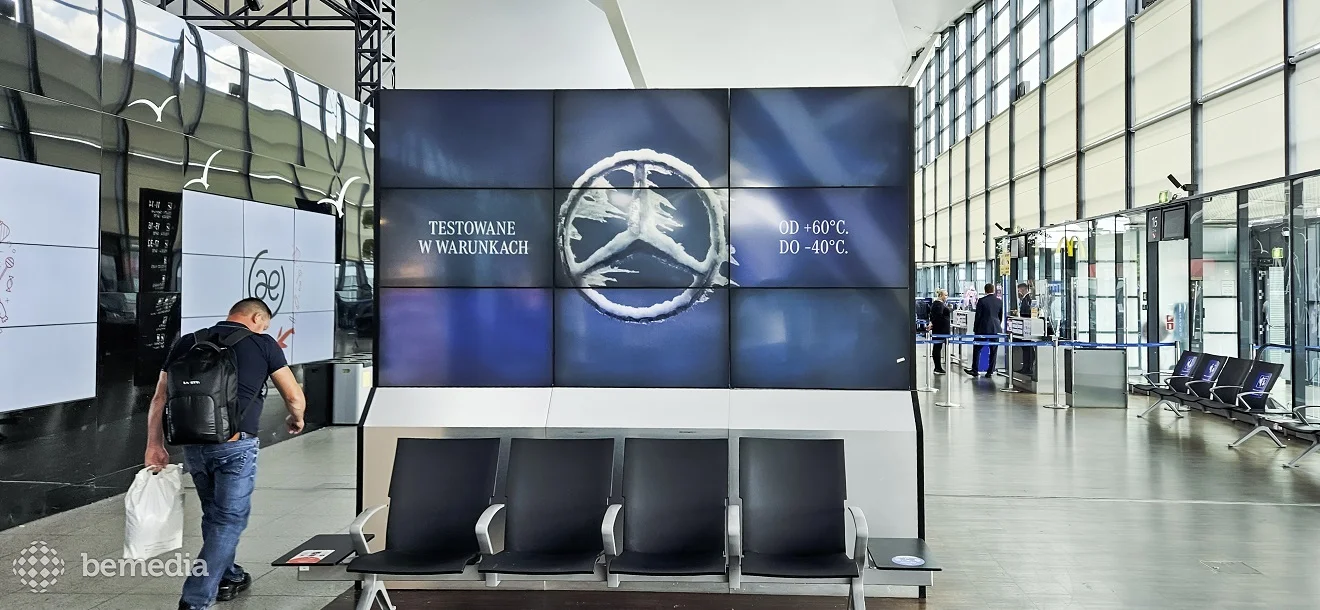
Effectiveness depends on campaign objectives. Static displays provide uninterrupted 100% share of voice and continuous visual permanence, making them ideal for long-term brand equity. Digital DOOH offers creative agility, full-motion visual impact, dayparting, and multi-asset rotations. Leading enterprise campaigns frequentlycombine both to maximize reach and frequency.
What are the size and format specifications?
Mechanical specifications vary according to the physical architecture of each airport facility. Standard backlit dioramas commonly measure 43 inches high by 62 inches wide, while large-format spectaculars can span 83 inches by 135 inches or custom architectural dimensions.
Digital formats range from standard 1080p and 4K vertical totems to custom-resolution ultra-wide LED video walls. Exact technical specifications must be confirmed directly during the campaign planning phase.