
Tram Advertising in Poland

A Mobile Billboard in the City’s Best Locations
Tram advertising places a brand in the most valuable parts of the city. Trams run mainly through strict city centres, business districts, retail areas and transport hubs, exactly where pedestrian, driver and passenger traffic is highest.
A wrapped tram becomes a mobile billboard that draws attention in locations where conventional advertising space is limited and costly.
Trams currently operate in fifteen of the largest Polish cities. In Warsaw alone, twenty-five tram lines are served by more than seven hundred wagons, which creates broad scope for mass-reach campaigns.
As an out-of-home (OOH) medium, tram advertising reaches not only passengers but also pedestrians, cyclists and drivers across different points of the city.
For international brands building presence in Poland, BE Media plans and runs the entire campaign locally, so this reach is available without marketing structures of your own in the country.
Why Trams Work as an Advertising Medium
A tram travels at an average speed of 15 to 30 km/h. At that pace the advertising is not a flash in the background but a full contact with the brand. Pedestrians, passengers and drivers waiting in traffic have time to notice the message, read it and remember it.
Compared with faster-moving vehicles, tram advertising:
- delivers a longer exposure time
- improves the legibility of the message and the branding
- supports stronger brand recall
- builds a repetition effect on fixed, high-traffic routes
Trams operate in spaces with heavy pedestrian movement, where attention is naturally more focused and contact with advertising is more deliberate.
There is also a regulatory advantage worth noting: as Polish cities tighten the landscape regulations that restrict traditional billboards, tram advertising offers a compliant and highly visible alternative in the same prime locations.

Tram Advertising Formats
We offer a range of tram formats and select each one to fit the goal of the campaign, the audience and the budget.
Exterior Tram Advertising
- Full wrap. The entire wagon can be covered with the campaign graphics, creating a striking mobile billboard.
- Side panel. A side banner that provides clear visibility for pedestrians and drivers.
- Rear advertising. An effective format for reaching people travelling behind the tram.
- Creative use of the tram shape. Non-standard ambient campaigns that set a brand apart.
Interior Tram Advertising
- New-generation LCD screens. Screens that display dynamic HD spots inside the wagon.
- Premium frames. Posters and graphics placed above the passenger seats.
Passengers spend an average of 20 to 40 minutes in a tram, which is enough time to engage with the message several times and to remember the brand. Therefore, in-tram advertising builds a sustained relationship with the audience: a passenger returns along the same route every day and has repeated contact with the message.
On the technical side, we apply specialist One Way Vision (OWV) film to the windows, which carries the advertising without limiting passengers’ visibility, and weather-resistant film on the bodywork, so the campaign can run throughout the year without loss of quality.


Advantages of Tram Advertising
- Broad reach in city centres, where pedestrian and vehicle traffic is highest.
- A favourable cost per contact relative to the audience covered.
- A dynamic, moving medium that draws attention in the urban landscape.
- Precise territorial targeting through the choice of specific lines.
- High visibility on fixed, high-traffic routes.
- Resistance to weather conditions, with film that supports long exposure.
- A compliant alternative to billboards under current landscape regulations.

Where We Run Campaigns
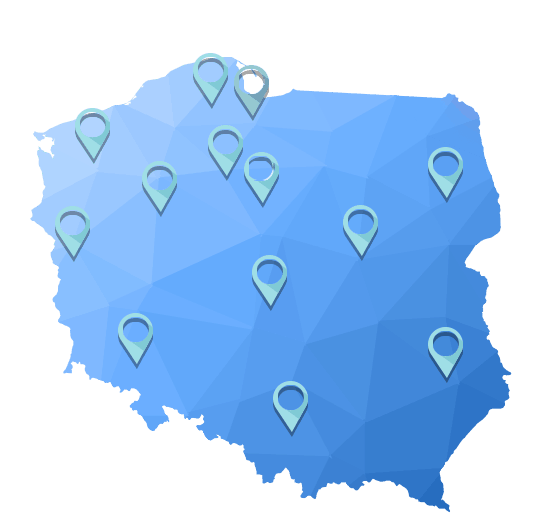
We run tram advertising campaigns in the fifteen Polish cities served by tram networks, in cooperation with municipal transport operators. This gives access to hundreds of wagons running on the busiest routes, from Łódź and Poznań to Cracow, Gdańsk, Katowice and Szczecin.
Each tram passes through the key points of the city, which makes it possible to reach different audiences naturally and without intrusion.
Working With BE Media
We handle the full process: graphic design, print, application of the film and the formalities with the transport operator. For international clients, this means a single point of contact, knowledge of the local market and the ability to run several formats without the need for your own structures in Poland.
BE Media brings 15 years of experience in out-of-home advertising and has delivered hundreds of campaigns for leading brands.
Part of a Multiformat Campaign
Tram advertising complements other out-of-home formats well, and we frequently combine tram campaigns with bus and metro advertising, billboards, LED screens and advertising at stops.
Each touchpoint plays a different role along the customer journey:
- a tram side panel builds awareness among pedestrians and drivers
- an in-tram LCD screen deepens the message among passengers
- advertising at stops reinforces contact in the moment of waiting



Trusted by Leading Brands


Plan Your Tram Campaign
Let us plan a tram campaign matched to the goals of your brand. Contact BE Media for a recommendation of formats and locations and an individual quote prepared around your objectives, audience and the scale of your campaign.


Frequently Asked Questions
The cost depends on the format (full wrap, side panel or interior frames), the city, the number of wagons and the duration of the campaign. Every campaign is priced individually and matched to your objectives, so contact us for a quote prepared for your specific plan.
Yes. We use specialist film resistant to UV, rain and frost. Both the application and the later removal are straightforward and do not damage the vehicle’s paintwork.
We run campaigns in the fifteen cities served by tram networks, including Warsaw, Cracow, Wrocław, Poznań, Gdańsk, Katowice, Łódź, Szczecin, Bydgoszcz and Toruń.
The minimum period is usually one month, and a campaign can run for many months. Longer campaigns are more favourable in cost terms, thanks to discounts for long-term cooperation.