
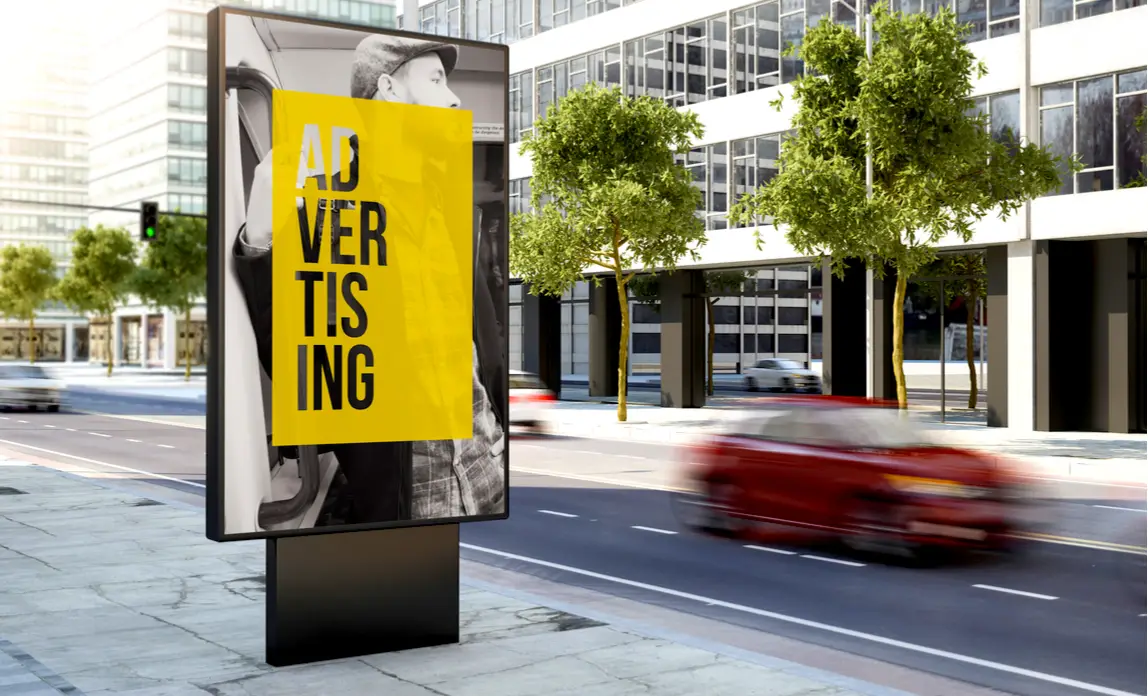

How does billboard advertising build measurable brand awareness and market presence in a fragmented media landscape? By establishing physical presence in high-traffic urban environments, out-of-home (OOH) and digital out-of-home (DOOH) formats deliver continuous exposure that audiences cannot skip, block, or scroll past.
This guide examines billboard formats, strategic media planning, pricing dynamics, design requirements, and performance attribution to support data-driven campaign decisions.
What is billboard advertising?
Billboard advertising is a high-visibility out-of-home format that displays commercial messaging across large-format structures positioned in major public spaces. Positioned along arterial roadways, transit corridors, commercial districts, and transit hubs, billboards provide brands with consistent audience exposure throughout daily commuter routines.
Within an integrated media mix, billboard placements operate alongside transit advertising, indoor networks, and street furniture to establish comprehensive reach across public spaces.
Unlike digital channels where ad fatigue and ad blockers limit viewability, physical outdoor media occupies real space in the consumer environment. Repeated exposure across key commuter routes builds message recall and strengthens long-term brand equity.
Common billboard formats and categories
Selecting the appropriate billboard format depends on campaign objectives, viewing distance, and target audience movement:
- Bulletins: Large-format structures engineered for high-speed vehicular traffic along motorways and expressways. Standard dimensions include14×48 feet and 10×40 feet, optimized for rapid message absorption from substantial viewing distances.
- Posters: Intermediate formats deployed along urban surface streets, retail corridors, and secondary arterial roads. Common configurations include 30-sheet (approx. 12×24 feet) and 8-sheet junior posters, capturing both vehicular and pedestrian traffic.
- Spectaculars: Custom, ultra-large installations located in prime metropolitan hubs. These high-visibility landmark formats leverage custom illumination, architectural integration, and high traffic density to command premium brand attention.
- Wallscapes: High-impact displays affixed to prominent building facades. Utilizing vinyl or direct hand-painted treatments, wallscapes dominate urban sightlines and provide high prestige for landmark brand campaigns.
Static versus digital billboards: Key features
Modern OOH media planning leverages both classic static structures and digital screens (DOOH), each serving distinct strategic functions:
Static billboards
- Deliver 100% share of voice (SOV), maintaining uninterrupted 24/7 visibility throughout the campaign cycle.
- Build sustained brand recognition and long-term awareness over extended flighting periods.
- Accommodate bespoke physical production elements, such as 2D/3D extensions, embellishments, reflective vinyls, and specialized lighting.
- Require lead time for high-resolution wide-format printing and field installation.
- Typically operate on standard four-week cycles or multi-month commitments to maximize cumulative exposure.
Digital billboards (DOOH)
- Allow dynamic content deployment without print production cycles.
- Operate on a shared loop structure, displaying individual brand creatives in standardized time slots (commonly 6 to 10 seconds).
- Support dynamic creative optimization (DCO) based on contextual triggers such as time of day, weather conditions, live data feeds, or traffic density.
- Facilitate high-impact visual formats, including anamorphic 3D creative and motion-enhanced visuals where local regulations allow.
- Enable flexible scheduling for tactical promotions, product launches, and multi-version creative rotations.
How billboard advertising fits into out-of-home (OOH) marketing
Billboards serve as the foundational reach vehicle within out-of-home media strategies. Because physical advertising operates as an unskippable medium in public environments, it establishes high authority and brand trust.
Strategic media planning demonstrates that OOH presence significantly amplifies performance across digital and retail channels:
- Cross-channel research from Comscore indicates that exposure to outdoor advertising directly drives digital consumer actions, including search engine queries, social engagement, and website visits.
- Neuroscience studies by Ocean Neuro Insights indicate that prior exposure to OOH formats elevates consumer engagement with subsequent mobile display ads by up to 48%.
- Econometric modeling by Benchmarketing demonstrates that adding OOH to the media mix improves paid search return on ad spend (ROAS) by approximately 40%.
- Data from industry bodies demonstrates that multi-channel campaigns combining outdoor formats with online media deliver substantial conversion uplifts compared to isolated channel executions.
Plan your billboard campaign across Poland’s top locations


FILL OUT THE FORM
GET A FREE QUOTE AND CONSULTATION!
How does billboard advertising work?
Executing an effective outdoor campaign requires precise coordination across audience profiling, inventory selection, creative production, and technical verification. Achieving optimal return on investment depends on matching format characteristics to specific campaign goals.
Billboard advertising process: From planning to installation
A structured billboard campaign follows a defined implementation framework:
- Strategic campaign planning: Define primary KPIs, whether focused on brand equity, localized footfall, launch awareness, or direct action, and map out the role of OOH alongside digital and indoor touchpoints.
- Budget allocation: Model expenditures across media placement, format production, dynamic scheduling fees, and independent attribution tracking.
- Inventory selection and booking: Evaluate specific locations, visibility indices, traffic flow directions, and share-of-voice parameters.
- Creative adaptation: Develop high-contrast, readable key visuals optimized for quick message comprehension at varying approach speeds.
- Production and quality control (static): Produce high-grade, weather-resistant vinyl prints, factoring in finishing, structural extensions, and lead times.
- Execution and verification: Coordinate physical posting for static units or ingest digital assets into content management systems, followed by verified proof-of-performance reporting.
What is required to launch a billboard campaign?
Launching a campaign requires defined strategic inputs:
- Explicit campaign objectives tied to target audience mobility patterns.
- Media budget covering display flighting, physical production, and installation costs.
- Production-ready artwork formatted to site-specific technical specifications and contrast guidelines.
- Approved media contracts defining flight dates, geographic distribution, and delivery guarantees.
Where should you place your billboard?
Location selection represents the primary determinant of campaign effectiveness. A compelling visual concept underperforms on a compromised structure, whereas precise placement ensures direct contact with high-value consumer groups.
Key location factors: Visibility, audience, and traffic
Evaluating individual display locations requires analyzing critical spatial metrics:
- Audience composition: Demographic and behavioral alignment with target profiles provides higher return than unsegmented, raw vehicle counts.
- Approach and dwell time: The duration a driver or pedestrian has clear sightlines toward the face. High-speed highways demand ultra-concise messaging, whereas signalized intersections provide longer dwell times for contextual communication.
- Facing and travel direction: Displays facing primary commuter flows toward major commercial centers deliver higher impact than outbound or angled positions.
- Proximity to point of interest: Positioning assets along key access routes to retail centers or corporate districts facilitates rapid conversion.
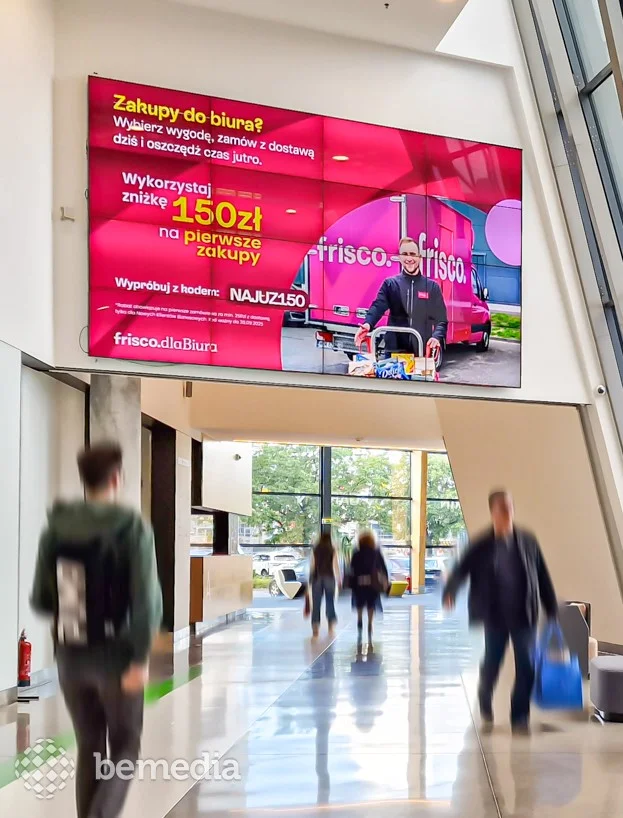
A vibrant digital advertising display captures visitors’ attention in a high-traffic indoor space, demonstrating the impact of large-format screens in reaching audiences on the move.
How to choose the right billboard site for your brand
Selecting suitable inventory involves combining data-driven audience modeling with physical site validation:
- Align structure type with campaign intent: high-reach arterial bulletins for national awareness, or concentrated urban posters for localized retail support.
- Evaluate environmental context: ensure the surrounding architectural landscape reinforces brand positioning.
- Audit approach angles to confirm the board sits directly within the natural field of vision without requiring severe head turns.
What can impact visibility?
Physical sightline audits are essential to ensure ad delivery is not compromised by environmental factors:
- Vegetation growth and seasonal foliage obscuring panels during spring and summer months.
- Urban infrastructure changes, such as new road construction, overhead utility poles, or directional traffic signs.
- Inadequate nighttime illumination or uneven lighting distribution on static boards.
- Excessive setback distance from the road relative to the physical dimensions of the board.
- Extreme traffic speeds that compress readable dwell time below three seconds.
What does billboard advertising cost?
Billboard pricing reflects market demand, audience volume, location quality, and production complexity. Strategic planning balances media investment with format selection to achieve optimal CPM efficiency.
Factors influencing billboard pricing
Rate cards and realized media costs depend on several clear variables:
- Market tier and location profile: Major metropolitan centers command higher rates than secondary or regional markets due to population density and limited inventory supply.
- Format classification: Iconic landmark spectaculars and high-traffic bulletins require higher investment than standard street posters.
- Static versus digital infrastructure: Static placements provide complete share of voice over extended periods, whereas DOOH pricing reflects slot share, loop duration, and programmatic flexibility.
- Campaign duration: Longer flight durations allow advertisers to secure favorable daily and weekly rate structures.
How much does it cost to rent or buy a billboard?
In standard industry practice, advertisers lease space across existing media structures rather than purchasing structural assets.
Media investment benchmarks vary by market scale and placement prestige:
- Regional and secondary markets: Display space typically ranges from moderate daily rates for localized posters to mid-tier pricing for arterial bulletins.
- Major metropolitan markets: Prime urban displays and motorway bulletins require substantial investment reflecting dense traffic and audience indices.
Static campaigns require separate production budgeting:
- Vinyl printing and finishing calculated per square foot or meter.
- Physical installation, structural mounting, and takedown labor.
- Special fabrication expenses for extensions, custom cut-outs, or specialized illumination.
Should you negotiate with providers?
OOH media buys allow for strategic negotiation. Media buyers can optimize budget efficiency by committing to multi-market packages, booking extended flight schedules, or utilizing off-peak seasonal cycles. Direct planning with specialized media partners provides transparent inventory access and optimal placement efficiency.
Budgeting for your billboard campaign
A comprehensive campaign budget accounts for all execution components:
- Net media display costs (rental or digital loop time)
- Creative design and technical adaptation
- Physical print production, logistics, and installation labor (static)
- Dynamic data feeds, CMS scheduling, and interactive features (DOOH)
- Independent campaign verification and attribution modeling
Go bigger with large-format banners and building illuminations
What are the steps to booking a billboard?
Navigating inventory procurement requires structured coordination between media planners, operators, and creative teams to align campaign flight dates with asset delivery.
Direct purchase, brokers, and online platforms: Pros and cons
Media inventory can be procured through several strategic paths:
| Procurement Method | Key Advantages | Strategic Considerations |
| Direct Media Partners & Agencies | Cross-format media planning, strategic network selection, unified campaign reporting | Requires defined campaign timelines and advance planning |
| Single-Operator Direct Buys | Direct communication regarding specific proprietary sites | Restricted strictly to that individual operator’s geographic footprint |
| Self-Serve Digital Platforms | Fast access for flexible, low-commitment digital ad triggers | Limited strategic consultation and lower prioritization for prime high-demand inventory |
Artwork submission and approval process
Once inventory is locked, asset preparation follows technical guidelines:
- Operators issue mechanical specifications detailing pixel dimensions, color profiles (CMYK for print, RGB for DOOH), DPI standards, and safety margins.
- For static media, high-resolution print files are formatted and color-proofed prior to vinyl production.
- For digital media, static image or video assets are delivered in specified containers (JPG, PNG, MP4) matching screen resolution.
- Pre-flight visual proofs are reviewed to confirm legibility, contrast, and absence of typographical errors.
- Approved digital assets are scheduled within the CMS; physical prints are dispatched for regional field installation.
Permits and regulations you need to consider
Outdoor advertising operates under local, municipal, and national regulatory frameworks governing structural safety, illumination limits, environmental conservation, and restricted product categories (such as alcohol, gambling, or prescription pharmaceuticals).
In standard commercial media rentals, structural permits, lighting compliance, and engineering safety are maintained directly by the media operator.
How to design effective billboard ads
Designing for out-of-home media requires an understanding of glance viewing and rapid visual processing. Because target audiences encounter messaging while in motion, creative execution must deliver high clarity within seconds.
Billboard design tips and best practices
Apply foundational creative principles for high-speed visibility:
- The glance test: Creative concepts must communicate the core message within 3 to 5 seconds of initial exposure.
- Copy discipline: Restrict text copy to 7 words or fewer to enable instant comprehension.
- Single visual hierarchy: Focus on one dominant visual element and a singular proposition to eliminate cognitive clutter.
- High tonal contrast: Use strong color contrast between typography and background elements (e.g., dark text on light backgrounds or high-contrast chromatic pairings) to maximize legibility across varying daylight conditions.
- Dimensional extensions: On static formats, structural cut-outs extending beyond standard rectangular frames break visual expectations and increase message recall.
What makes billboard copy successful?
Outdoor copywriting prioritizes conciseness and punchy phrasing:
- Lead with a focused, singular benefit.
- Avoid multi-line paragraphs, dense subtext, or secondary bullet points.
- Provide an easily memorable brand cue or single call to action, such as a clear brand search term or simple website domain.
- Eliminate complex URLs, QR codes placed in high-speed traffic zones, and lengthy phone numbers that drivers cannot record safely.
Visual elements that boost impact
Visual composition directs audience focus across the board:
- Select heavy, sans-serif typefaces with open counters and generous kerning to prevent letterforms from blurring at distance.
- Ensure brand logos occupy prominent real estate with sufficient negative space around them.
- Utilize professional, high-resolution product photography with uncluttered backgrounds.
- On premium digital screens, leverage subtle contextual motion and depth design to capture attention without distracting drivers.
Design considerations for digital versus static billboards
Creative execution adapts to the specific technical properties of the format:
Static creative
- Designed for constant, long-term exposure where single-image visual longevity is paramount.
- Enables specialized physical materials, extensions, reflective surfaces, and bespoke lighting fixtures.
Digital creative
- Allows for contextual messaging matched to specific dayparts (e.g., breakfast vs. evening commute) or real-time conditions.
- Accommodates sequential storytelling across consecutive digital faces along a defined traffic corridor.
- Demands strict adherence to local motion and transition regulations (e.g., static slide changes without rapid flashing).
How to measure billboard advertising performance
Modern out-of-home measurement has evolved into a sophisticated discipline combining mobility data, audience modeling, and multi-touch attribution to assess real-world business impact.
Which metrics are relevant for outdoor campaigns?
Evaluating outdoor campaign delivery relies on industry-standard audience metrics:
- Likely-to-See (LTS) impressions: Modeled audience figures that account for vehicle speed, sightline angles, setback, and illumination to quantify actual visual contact opportunities rather than raw vehicular road passage.
- Effective frequency: The average number of times an individual within the target demographic encounters the campaign during a set time frame.
- CPM (Cost Per Thousand): Standardized cost efficiency metric allowing cross-channel comparison against digital, television, and radio media.
- Brand lift indices: Independent pre- and post-campaign research tracking shifts in unaided awareness, brand consideration, and message association.
Attribution and tracking in billboard advertising
Measuring downstream business outcomes utilizes several established attribution methodologies:
- Matched-market testing: Comparing sales velocity, web traffic, or search volume in target markets exposed to billboard campaigns against demographically similar control markets without outdoor media.
- Mobile location data and footfall attribution: Tracking aggregate, anonymized foot traffic patterns to measure incremental physical store visits among exposed consumer devices.
- Search and digital uplift tracking: Measuring correlated spikes in branded organic search queries, direct website traffic, and digital conversion rates during campaign active flights.
- Unique response mechanisms: Deploying campaign-specific digital landing pages, promotional codes, or custom vanity URLs to track direct conversions.
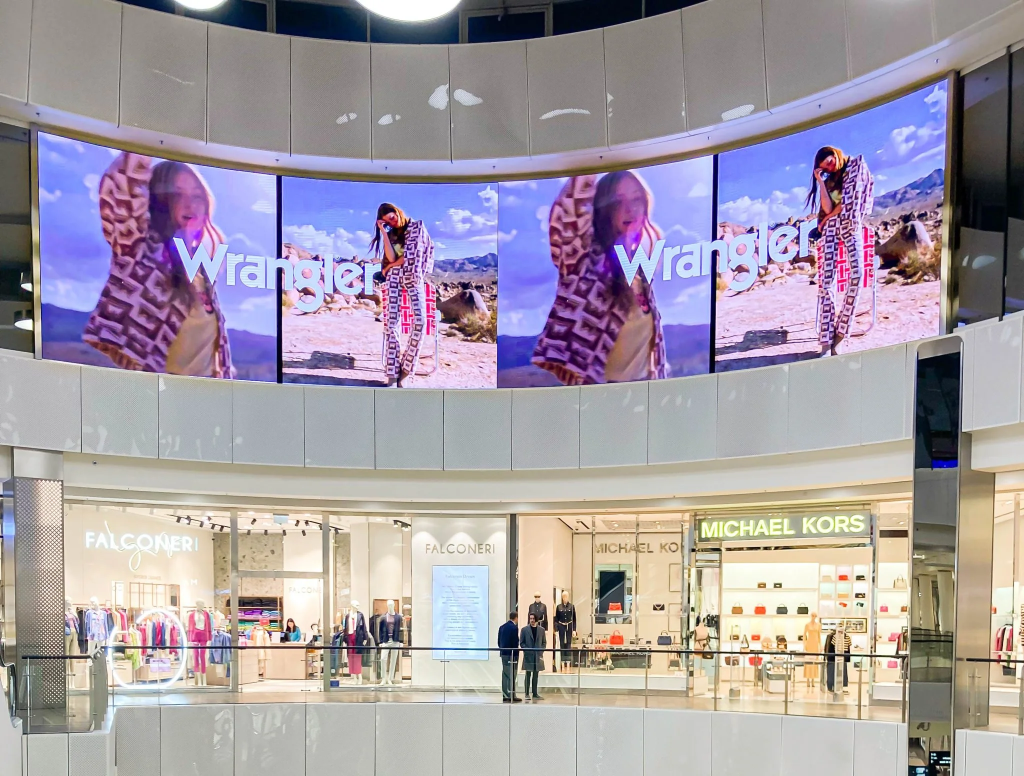
A panoramic digital display brings fashion advertising to life, using vibrant visuals and an impressive curved format to attract shoppers’ attention in a premium retail environment.
When does billboard advertising make sense for your business?
Billboard media proves exceptionally effective for mid-sized and large enterprises seeking to build market authority, support product launches, drive retail traffic, or reinforce nationwide brand presence.
Integrating billboards with digital and traditional marketing
Outdoor media functions as an effective multiplier when strategically coordinated with other channels:
- Top-of-funnel reach: Billboards establish public awareness and trust across broad audiences.
- Middle-funnel reinforcement: Mobile and programmatic digital ads retarget users within geographical proximity of billboard sites, deepening engagement.
- Bottom-of-funnel conversion: Paid search and retail promotions capture high-intent demand generated by sustained physical outdoor visibility.
Key considerations before starting a campaign
Before committing media spend, verify these core planning elements:
- Ensure target demographics align with the geographic mobility data of selected sites.
- Allocate sufficient media flight duration (typically a minimum of 4 to 12 weeks for static) to build effective exposure frequency.
- Confirm all creative visual assets pass legibility and high-contrast evaluations at simulated distance.
- Establish clear pre-campaign baseline metrics to facilitate accurate post-campaign attribution.
Mistakes to avoid in billboard advertising
Maximize campaign effectiveness by avoiding common execution errors:
- Overcrowding layout space with multiple headlines, detailed lists, and small secondary imagery.
- Selecting inventory based purely on low unit cost rather than location visibility and audience quality.
- Using digital assets that fail visual contrast requirements under direct sunlight.
- Failing to coordinate outdoor launch timing with concurrent digital and trade marketing activations.
Conclusion
Billboard advertising remains one of the most reliable and influential formats for establishing brand presence across the physical world. Through continuous technological advancements in digital screens, dynamic scheduling, and audience measurement, out-of-home media bridges high-impact physical reach with precise cross-channel integration.
Executing an effective outdoor campaign requires looking beyond simple traffic volume. Success relies on strategic location selection, rigorous creative clarity, and aligning formats with defined business goals. When integrated into a comprehensive media plan, billboard advertising provides brands with continuous public visibility, strong audience trust, and measurable commercial impact.
Get a free quote for your billboard campaign
We will promote your business!
Frequently asked questions
How long do billboard campaigns last?
Standard static billboard contracts operate on four-week media cycles, with brand-building campaigns frequently running across multi-month or annual flights to maintain continuous market presence. Digital billboard campaigns offer greater flexibility, supporting shorter tactical flights alongside long-term strategic presence.
Can you change the message mid-campaign?
Digital billboards allow seamless creative rotation and dynamic updates via content management systems. Static billboards can be updated mid-campaign by printing and installing replacement vinyl skins, which requires scheduling additional production and installation lead times.
Do targeted billboard placements work for growth-focused brands?
Yes. Mid-sized and growing brands frequently leverage targeted billboard placements along key commercial corridors to establish high local authority, drive retail footfall, and project established market presence against larger competitors.
Who owns and maintains billboards?
Billboards are owned and operated by specialized media companies. Operators are responsible for structural engineering, permits, illumination maintenance, environmental safety, and routine physical upkeep of the site.
Are billboard ads effective for all industries?
Billboard advertising delivers proven performance across diverse commercial sectors, including automotive, consumer packaged goods (FMCG), pharmaceuticals, retail, financial services, telecommunications, entertainment, and employer branding campaigns requiring high market visibility.