
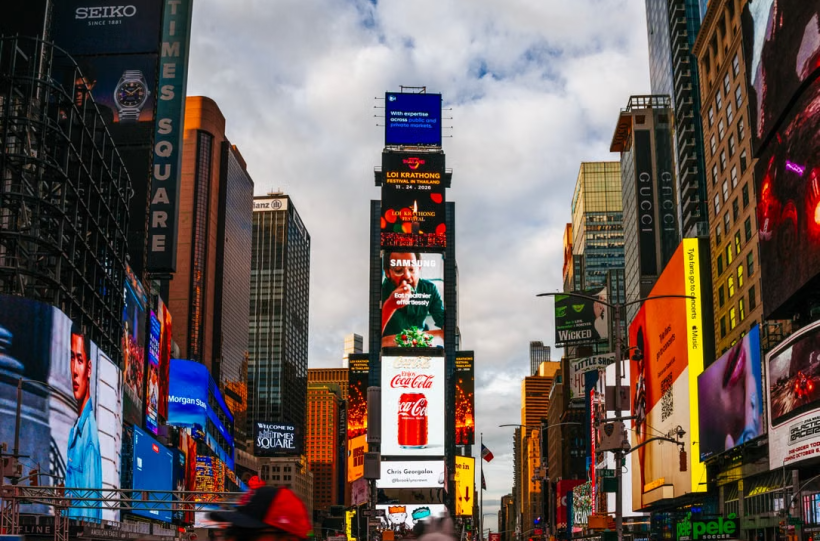
What is out-of-home (OOH) advertising, and how do brands build high-visibility campaigns in the physical world?
Out-of-home advertising encompasses all commercial media displayed across public spaces, transit networks, and dedicated indoor environments. It delivers unskippable brand exposure and steady contact frequency within the daily rhythm of urban audiences.
What is out-of-home advertising?
Out-of-home advertising includes any paid promotional display situated in public or commercial environments outside private residences.
Unlike digital browser ads or broadcast media, OOH operates directly within physical infrastructure: streets, transit hubs, retail locations, and high-traffic municipal zones. The medium reaches target demographics naturally as they commute, work, shop, and travel throughout the day.
From static roadside hoardings to dynamic digital networks, OOH embeds a brand message into the real-world environment. This physical presence establishes high visibility and sustained recall as audiences navigate urban landscapes.
What does OOH stand for in advertising?
OOH stands for “Out of Home” advertising. The term covers every advertising format positioned in shared public, transit, and venue-based environments, providing unified exposure across non-residential touchpoints.
How does OOH advertising differ from other advertising channels?
OOH delivers structural advantages over online and broadcast media. Most notably, OOH media cannot be skipped, blocked by ad-filtering software, or muted. The message integrates seamlessly into the physical surroundings, ensuring uninterrupted exposure.
Furthermore, OOH operates independently of third-party digital tracking, personal device identifiers, and changing privacy regulations.
Because it exists in tangible, shared public spaces, consumers perceive OOH as an authoritative, established medium of trust, strengthening brand credibility across diverse touchpoints.
See all OOH formats we offer in Poland →


FILL OUT THE FORM
GET A FREE QUOTE AND CONSULTATION!
What are the main types of OOH advertising?
Strategic media planning relies on aligning format, location, and audience mindset. The primary OOH categories serve distinct strategic objectives across various communication environments.
1. Billboard advertising
Billboards represent high-visibility staple formats positioned along major thoroughfares, intersections, and arterial routes. They deliver repeated vehicular and pedestrian exposure at scale.
Standard formats range from 6-sheet posters in urban centres to classic 48-sheet roadside billboards and 96-sheet large-format structures along expressways.
Digital billboards (LED screens operating in timed rotations) provide added flexibility for dynamic creative. Pricing structures reflect location density, traffic volume, and format size, ranging from localized 6-sheet units to premium high-traffic digital installations.
Billboards primarily drive broad brand recognition and launch momentum.
2. Transit advertising
Transit advertising integrates brand communication into public transport networks, including buses, trams, subways, and passenger rail systems. City transport formats move continuously through business districts, residential quarters, and commercial corridors, generating substantial daily impression volumes.
Transit solutions include exterior vehicle wraps, side panels, interior display posters, and passenger LCD screens. Subway and rail environments capture captive commuter attention during transit and wait times, combining long dwell periods with minimal environmental distractions.
3. Street furniture
Street furniture positions brand messages at eye level along pedestrian routes. Common applications include bus shelters, information kiosks, citylights, and freestanding urban panels.
Because these displays reside directly within pedestrian walkways and transit stops, they capture focused attention during brief pauses and provide directional proximity to retail destinations.
4. Place-based media
Place-based indoor media targets audiences within specific contextual environments. This includes medical facilities, pharmacies, office towers, corporate lobbies, higher education campuses, shopping malls, and airports.
Aligning the brand message with specific decision environments (such as healthcare contexts for wellness products or business centers for B2B solutions) ensures elevated relevance and higher quality of attention.
5. Digital out-of-home (DOOH) advertising
Digital out-of-home (DOOH) utilizes commercial LED and LCD screen networks across road networks, retail centres, transit hubs, and landmark architectural installations. DOOH delivers programmatic flexibility, rich multimedia animation, and daypart scheduling, enabling brands to adjust messaging based on time, context, or external triggers.
Specialized mobile DOOH formats, such as digital mobile display vehicles and mobile LED units, provide targeted tactical coverage for specific events, geographical perimeters, or high-density pedestrian gatherings.
Traditional OOH vs digital OOH: How do they compare?
Modern media plans regularly combine static and digital out-of-home formats to balance exclusive presence with tactical flexibility. Digital inventory continues to capture an increasing share of overall market investment, yet each format serves a defined tactical purpose.
Key differences between print and digital OOH
Traditional print OOH utilizes printed paper or vinyl substrates, securing 100% share of voice on the designated structure throughout the campaign flight. Print installations require fixed production lead times and physical mounting, delivering a permanent, uninterrupted visual anchor for long-term branding.
Production standards for print require high-resolution CMYK artwork configured precisely to physical dimensions, with proper bleed allowances for mounting hardware.
Digital OOH relies on commercial screen networks showing scheduled rotations, typically sharing screen time among multiple non-competing advertisers. Content deployment occurs electronically with short turnaround times, enabling creative adaptation, dayparting, and data-driven audience targeting.
DOOH creative utilizes RGB color profiles, specific display aspect ratios, and strict technical guidelines regarding contrast and luminosity to ensure clarity across varying ambient light conditions.
Benefits and strategic considerations of digital out-of-home advertising
DOOH offers dynamic creative execution, motion graphics, contextual triggers, and rapid asset deployment. Brands can adapt messages according to weather conditions, time of day, or specific campaign phases.
The shared screen model means total exposure depends on loop length and frequency of rotation. Selecting between static 100% share-of-voice placements and dynamic DOOH rotations depends on whether uninterrupted physical dominance or contextual agility is the core strategic goal.
Compare digital OOH (DOOH) screens and their reach →
What are the benefits of out-of-home advertising?
OOH occupies a critical role within multichannel media strategies, providing tangible scale, consistent reach, and verified brand authority.
1. High reach and mass exposure
OOH establishes broad public reach by meeting consumers across their daily journeys. Strategic network placement across roadside, urban, and transit touchpoints accumulates millions of verified impressions weekly, establishing immediate market presence and widespread familiarity.
2. Cannot be skipped, blocked, or muted
OOH operates entirely outside ad-blocking technologies and screen fatigue. Integrated directly into the urban fabric, it commands natural attention without relying on consumer device engagement.
3. Builds brand recognition and authority
Large-format outdoor presence confers prestige and institutional scale. Physical installations in high-profile urban locations signal brand stability, driving long-term recognition and trust significantly more effectively than fragmented digital channels.
4. Influences people at decision points
OOH reaches consumers directly along the path to purchase. Placements near shopping centres, commercial districts, medical centers, and transport nodes serve as final contextual reminders that transition consideration into concrete action.
5. Drives online and offline action
Physical media exposure directly stimulates digital response. Strategic OOH campaigns generate measurable uplifts in branded search volume, web traffic, and social engagement. Integrating OOH with digital retargeting and footfall attribution enables end-to-end measurement from spatial exposure to physical store visits and digital conversions.
How to plan an effective OOH campaign
A successful OOH deployment requires systematic media planning, clear audience profiling, and precise alignment between creative execution and viewing context.
Define your marketing objective
Establish the primary campaign objective prior to format selection. Whether the goal is long-term brand equity, nationwide product launch, contextual audience education, employer branding, or driving foot traffic, a focused objective determines the appropriate format mix, flight length, and distribution strategy.
Identify and analyze your target audience
Examine consumer mobility patterns, commuting routes, and venue touchpoints. Demographic segments require distinct environments: corporate decision-makers are best reached within business districts and office networks, students within academic hubs, and general consumers across arterial roads and public transit.
Mobility data and spatial analytics clarify where target segments spend time, ensuring strategic budget allocation across the most relevant locations.
Select OOH formats and placements
Develop a balanced media mix incorporating appropriate formats: large-format roadside billboards for scale, transit media for continuous citywide movement, contextual indoor networks for focused attention, and digital landmarks for prestige. Media planners use verified audience measurement data to optimize reach and contact frequency within target markets.
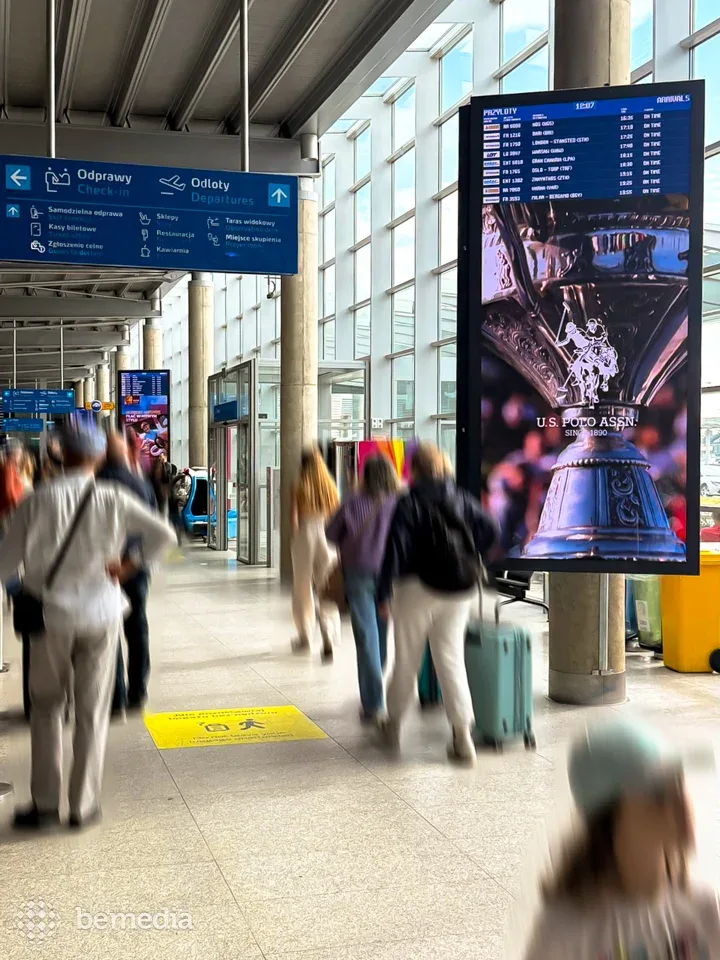
Large digital displays help airports combine passenger information with prominent advertising in high-traffic areas.
Develop creative concepts and artwork
OOH creative must communicate instantly. Because visual contact often lasts only a few seconds, designs require high contrast, concise copy, bold branding, and clear focal hierarchy. Technical specifications for print (CMYK) and digital (RGB) must be rigorously applied to guarantee visual impact.
Launch, monitor, and optimize your campaign
Coordinate production and digital scheduling for seamless campaign deployment. Verification reporting, including installation photography and network logs, confirms execution integrity.
Post-campaign analysis evaluates reach, frequency, branded search lifts, and attribution metrics to inform subsequent campaign cycles.
7 tips for creating eye-catching OOH ads
Compelling OOH design captures immediate attention and conveys a singular, memorable message. Apply these seven strategic principles tooptimize your OOH creative execution.
1. Keep your message simple and clear
Design for audiences in motion. Roadside and transit displays require instant comprehension within three to five seconds. Restrict copy to seven words or fewer, focus on one core proposition, and eliminate unnecessary visual noise.
2. Use bold colors and high contrast
Ensure strong contrast between background elements and foreground typography to maintain legibility in direct sunlight, overcast weather, and night illumination. Distinct color palettes cut through busy urban backgrounds and strengthen immediate brand recall.
3. Make text large and easy to read at a distance
Select clean, bold typefaces with clear letter spacing. Avoid complex script fonts, thin weights, or condensed styles. Sentence case or title case generally provides faster readability at long distances than continuous uppercase blocks.
4. Choose impactful and relevant visuals
Utilize a single, dominant, high-resolution visual anchor rather than fragmented image collages. Ensure your imagery aligns directly with the central proposition, maintaining recognizable brand guidelines and visual cues.
5. Design for the specific context and location
Tailor creative assets to the physical environment. High-speed roadside formats demand minimalist clarity, while indoor transit stations and corporate spaces allow for richer contextual messaging. Direct geographical or cultural relevance substantially elevates audience engagement.
6. Include a strong call-to-action
Direct the viewer clearly toward the next step, whether that involves a short URL, directional navigation, or clear brand retention. Keep digital prompts simple, legible, and uncluttered.
7. Test, measure, and refine your creative
Pre-test visual assets across simulated viewing distances and variable lighting environments before full production rollout. In digital campaigns, deploy creative variations to calibrate messaging against performance data and market response.
We will promote your business!
Frequently asked questions about OOH advertising
Understanding format capabilities, commercial planning cycles, and measurement standards ensures seamless campaign deployment.
Can campaigns be tailored for specific budget levels?
OOH offers modular deployment options across various formats and market tiers. Advertisers can scale campaigns from targeted single-format placements within specific indoor networks or transit routes to expansive, multi-city large-format takeovers, aligning investment with defined strategic targets.
How is OOH campaign success measured?
OOH effectiveness is evaluated through established industry measurement methodologies:
- Audience measurement data: Verified circulation, visibility-adjusted impressions, and reach/frequency modeling.
- Brand lift studies: Pre- and post-campaign research tracking shifts in brand awareness, consideration, and preference.
- Branded search and direct response: Correlating campaign flight dates with uplifts in search volume, web traffic, and promo code usage.
- Footfall attribution: Mobile location analytics tracking real-world visitor traffic to physical venues following media exposure.
How far in advance should you book OOH placements?
Lead times vary by medium type. Static large-format structures and high-demand premium locations typically require advance planning of several months to secure optimal availability and complete production. Standard digital OOH networks offer programmatic and flexible scheduling, enabling execution within substantially shorter operational timelines.