
How can brands reach high-value domestic and international audiences in Poland through airport advertising? Strategic airport media planning connects brands with business decision-makers, affluent consumers, and incoming travelers during extended dwell times across key Polish terminals.
By matching formats to the passenger journey, campaigns build brand recall, establish prestige, and drive measurable market engagement.
Airport advertising in Poland: market overview and growth potential
Airport advertising in Poland has evolved alongside the rapid modernization of the country’s transport infrastructure. Air travel continues its upward trajectory, mirroring a global market that saw an estimated 9.5 billion passengers in 2024 with sustained growth projected for subsequent years.
As passenger volumes across Polish hubs expand, airport environments have become essential channels for high-visibility marketing.
The global airport media sector is expanding steadily, moving from approximately $4.24 billion in 2024 toward a projected $7.43 billion by 2033. For marketers operating in Poland, this trend reflects increased demand for media environments that combine physical scale, context, and premium audience attention.
Why Polish airports provide unique advertising opportunities
Polish airports provide distinct commercial advantages for media planning. Terminals are controlled environments where audience dwell time significantly exceeds typical outdoor touchpoints. Passengers navigate through defined stages-check-in, security screening, gate areas, and arrivals-creating a sequence of moments with high visual availability.
This setting is particularly suited for premium brands, B2B services, and international campaigns. Audiences in transit exhibit higher average purchasing power, while the modern architecture of Polish terminals reinforces perceptions of reliability, quality, and leadership for advertised brands.
Passenger traffic trends and aviation industry growth in Poland
Poland’s aviation sector has seen substantial expansion over the past two decades. What was once a market concentrated primarily around the capital has developed into a dynamic network of international hubs and specialized regional gateways connected to major European and intercontinental destinations.
Today, Poland operates around 15 commercial airports. While Warsaw remains the primary international gateway, regional airports handle significant passenger volumes. This distribution allows media planners to tailor campaigns geographically, targeting specific regional demographics, business corridors, or inbound tourism routes.
Key airports in Poland for advertising reach
Campaign effectiveness depends on selecting airports aligned with the campaign target profile:
Warsaw Chopin Airport serves as the central international hub, capturing corporate leaders, diplomatic travelers, and broad international traffic. Large regional hubs (such as Krakow-Balice, Gdansk Lech Walesa, Katowice, and Wroclaw) provide access to concentrated business clusters, industrial regions, and high-volume tourist corridors.
Strategic media agencies like BeMedia plan and coordinate multiformat campaigns across these key locations, matching format selection, terminal placement, and exposure frequency to specific brand objectives.
See our airport advertising formats →


FILL OUT THE FORM
GET A FREE QUOTE AND CONSULTATION!
Who can you reach with airport advertising in Poland?
Airport advertising reaches a curated demographic mix characterized by high disposable income, active decision-making roles, and openness to commercial messages during transit.
This audience environment supports diverse marketing objectives, from luxury goods and automotive campaigns to enterprise B2B software and corporate branding.
Captive and diverse audience demographics
The structural advantage of airport media lies in passenger dwell time. The average air traveler spends over two hours inside a terminal across check-in, security, retail areas, and boarding gates. Unlike roadside billboards seen for brief seconds, airport displays benefit from sustained, repeated exposure.
As passengers move through terminal checkpoints, they encounter visual touchpoints at multiple stages. This prolonged exposure increases message retention across diverse demographic groups.
Reaching decision-makers, business professionals, and affluent travelers
Airports provide direct access to corporate decision-makers and high-net-worth individuals. Business travel accounts for roughly 40% of airport foot traffic.
C-suite executives are approximately three times more likely to be found in airport terminals than in the general population.
Data indicates that 9 out of 10 business decision-makers take direct action after seeing B2B airport advertising, and 80% state they are more likely to consider a brand encountered in an airport setting. Furthermore, air travelers average 23% higher household affluence compared to broader population baselines.
Potential for B2B vs. B2C campaigns
The airport audience profile allows for targeted execution in both B2B and B2C segments:
For B2B brands, airports offer a focused environment to reach corporate leadership, investors, and procurement specialists. Enterprise software providers, financial institutions, and industrial firms useairport DOOH and large-format placements to reinforce category authority, especially around industry trade fairs and international conferences.
For B2C brands, arrivals zones and retail thoroughfares reach consumers at immediate decision points. Luxury apparel, premium automotive, consumer technology, and hospitality brands benefit from presenting messages to travelers in an aspirational, leisure-oriented mindset.
Key benefits of airport advertising in Poland
Airport advertising functions as a strategic media placement that builds brand stature, drives recall, and integrates with omnichannel campaigns.
Prestigious locations and premium brand positioning
Terminal architecture and high-profile environments confer immediate prestige. Research indicates that92% of air passengers associate airport advertising with international status, and 75% of frequent flyers link airport campaigns directly with market leadership. This context enhances brand perception far more effectively than fragmented digital channels.
High dwell times and repeated exposure
Terminal layouts create natural media sequences. An arrival or departure journey includes exposure at entrances, departures halls, digital screens in commercial areas, gate lounges, and baggage reclaim carousels. This structured repetition reinforces recall without causing ad fatigue.
Brand recognition and trust
Repeated exposure within a controlled, premium environment establishes commercial credibility. Studies demonstrate that 83% of frequent flyers actively notice airport advertising, with 75% taking subsequent actions such as online searches, service inquiries, or direct purchases.
Fit with global and local marketing goals
Airport campaigns bridge international brand strategies and localized market execution. Global enterprises can maintain visual consistency across central European transport nodes, while domestic brands can target specific commercial centers by selecting regional hubs based on target audience data, industry concentration, and travel routes.
Advertising formats available in Polish airports
Polish airports support a broad range of classic, digital, and experiential media formats suited to different stages of the passenger journey.
Digital Out-of-Home (DOOH) vs. classic static options
Modern terminals feature high-resolution DOOH networks alongside traditional static displays. DOOH screens and LED video walls support motion graphics, dynamic content delivery, and time-specific dayparting. Static media-including backlit dioramas, citylights, and illuminated tension banners-delivers continuous, unshared visual presence in high-traffic corridors.
Types of displays: billboards, lightboxes, video walls, and experiential zones
Standard and specialized formats available across Polish airports include:
- Backlit citylights and lightboxes: Positioned along concourses and waiting areas for sustained visual contact.
- Large-format LED video walls: High-impact digital screens situated in central departures halls and security zones.
- Baggage claim displays and carousel branding: Placed in high-dwell arrivals areas where passengers spend extended time waiting for luggage.
- Jet bridge wraps and gate branding: Capturing travelers at the point of boarding and disembarkation.
- Luggage trolley branding: Mobile advertising moving continuously throughout public and transit zones.
- Floor graphics: High-contrast directional media guiding passenger foot traffic.
- Brand experience zones and product showcases: Dedicated spaces for sampling, interactive product demonstrations, and customer engagement.
Integration with flight information display systems
Placing digital media adjacent to Flight Information Display Systems (FIDS) maximizes viewer attention. Passengers consult these displays repeatedly to verify gate assignments and boarding statuses, ensuring high viewability for adjacent brand messaging.
Audio and interactive technology in airport advertising
Airport campaigns increasingly incorporate interactive tools such as QR codes, augmented reality displays, and integrated landing pages, converting terminal attention into trackable engagement and immediate lead generation.
Airport campaigns for tourism and hospitality brands →
Factors affecting airport advertising costs in Poland
Pricing for airport advertising reflects the premium nature of the audience and media real estate. Budget allocations depend on specific operational variables.
Pricing variables: airport size, location, format, and seasonality
Costs are determined by four main factors:
- Passenger volume dictates baseline pricing; primary hubs command higher rates than regional facilities.
- Location within the terminal influences cost, with security zones, central retail areas, and baggage claim carousels carrying higher valuations due to dwell time.
- The format selected-from static posters to exclusive terminal takeovers and large LED walls-shapes production and media costs.
- Seasonal travel peaks during holiday periods or major business quarters influence demand and media availability.
Budget strategies for effective campaigns
Maximizing return on media spend requires alignment between campaign goals and location choices. Rather than broad, indiscriminate buys, media planning should focus on passenger composition.
A B2B campaign may achieve superior efficiency by focusing on specific business routes and regional hubs rather than broad general terminal coverage.
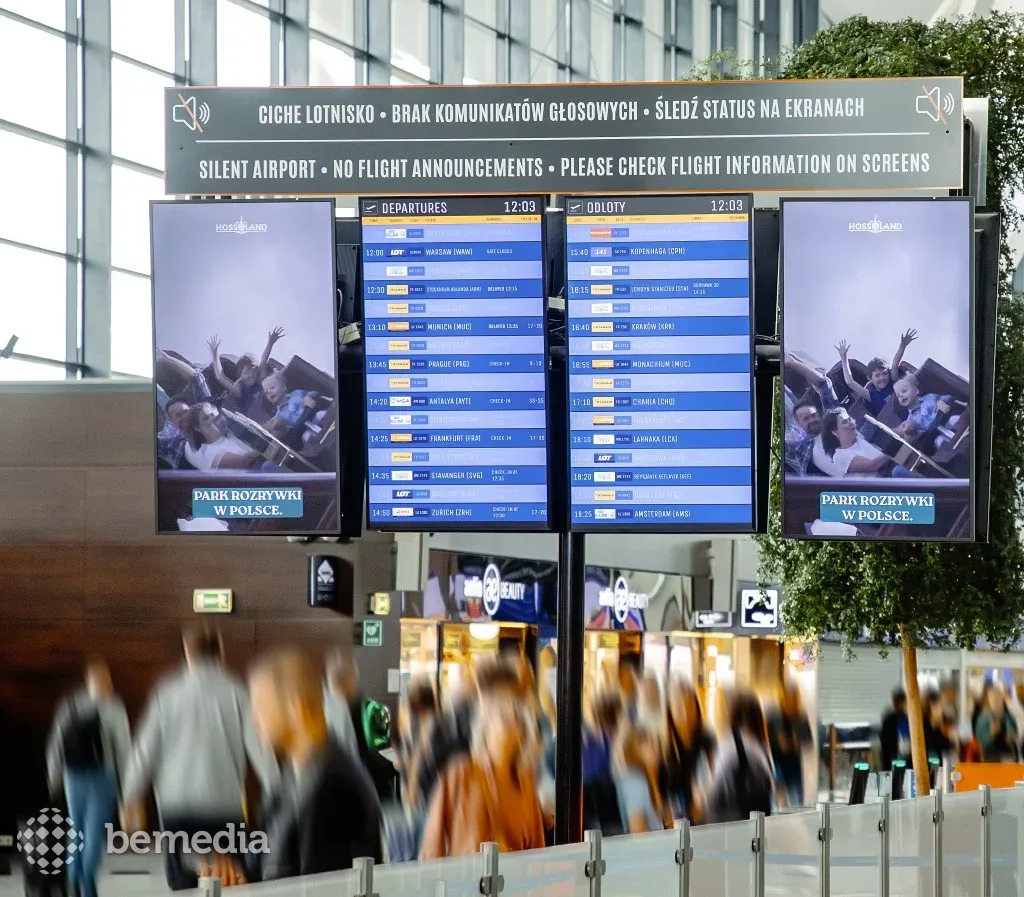
Passenger information and advertising share the same high-visibility zone, making digital screens a natural part of the airport journey.
How to plan a successful airport advertising campaign in Poland
Executing an effective campaign requires structured planning, precise targeting, and clean creative execution.
Identifying your ideal customer profile and campaign objectives
Media planning begins by defining target audience parameters and campaign objectives. Whether the goal is corporate repositioning, direct product launch, or regional retail support, defining the target profile determines which airports, terminals, and formats to deploy.
Strategic timing and message sequencing
Aligning campaign dates with industry events, trade exhibitions, or holiday travel periods concentrates media impact. Sequencing messaging along the passenger path-introducing a concept at check-in, detailing value near boarding gates, and presenting a call to action at baggage claim-reinforces message retention.
Creative best practices for maximum engagement
Effective airport creative emphasizes visual clarity, bold contrast, and concise messaging. Displays should be legible from varying distances across moving crowds, with clear typography and a focused value proposition.
Keeping brand consistency across channels
Airport media should align visually with broader out-of-home, digital, and print channels. Consistent branding across transit points reinforces brand familiarity and trust as travelers move through their journey.
Avoiding common mistakes in airport campaigns
Common planning errors include overloading displays with excessive text, selecting placements solely by total foot traffic while ignoring actual dwell time, and treating airport media as an isolated channel rather than part of an integrated multi-touchpoint media strategy.
We will promote your business!
Next steps for elevating your brand with airport advertising in Poland
Poland’s expanding air transit network offers valuable media opportunities for brands seeking visibility among high-value audiences. Extended dwell times and premium terminal environments support strategic campaigns that drive awareness and business results.
BeMedia plans and executes integrated OOH, DOOH, and transit campaigns across Poland, helping brands select the right formats, terminals, and exposure strategies for their commercial goals.